

CBC Youth Convention - Reality Check
Introduction
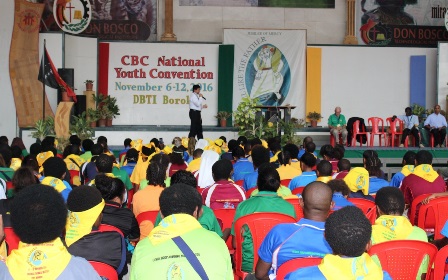
The data collection from the 330 participants of the Catholic Bishops Conference Youth Convention - Jubilee Year of Mercy from 6th to 13th November 2016 at Don Bosco Technological Institute have revealed the actual situation of the formation of the young people in the Catholic Church of Papua New Guinea. 282 from 330 could participate in the survey. These participants of the survey comes from 137 parishes of 16 dioceses in Papua New Guinea and were 148 male and 134 female. The majority of the participants’ are age between 14 and 25 - that was 80.62%.
A questionnaire was prepared with 32 questions and distributed to each individual to answer. The approximate time for the answering was two hours. After answering objectively ‘yes’ or ‘no’ each participant of the survey could write four or more reasons in order to justify his/her own position. As a result a wide variety of concerns have come out. There were no noticeable differences among the answers between male and female participants. In order to be brief, the most common findings are listed in this report.
1. Common emerging perspective: Basically, almost all the participants (91%) unanimously agree that no proper regular formation activities are organised at the parish community at all. However, 16% of them have said that a sort of ‘liturgical singing practice’ takes place when youth group animates the Holy Mass during the week for the following Sunday by the youth themselves in the parishes but it’s not guided by the parish priest or any other Catechist or Church leaders. 89% of them have said that the Diocesan Youth Coordinator organizes some workshops one or two times in a year at the diocesan level and at the same time they have also expressed that the dissemination of those workshops of the diocesan level are not brought to the parish level due to various reasons. 88% of them have reported that parish priests are not interested and cooperative.
2. Youth themselves are not able: When they were asked about what could be the possible reasons that the youth are not able to organize something for themselves at the parish level, there were several reasons emerged from the survey. No leadership and Support among the young people (87.59%), no interest among the young people (80.14%), peer pressure (78.37%), lack of self-confidence/courage (77.66%), Always look for an adult to lead the youth (75.53%) and no support from the elders/leaders of the communities (74.82%) were the major findings.
3. Formation at home: Interestingly, when the participants of the survey were asked about that whether they have received any formation at home from their parents or from the family members 140 of them have answered ‘yes’, 97 of them have answered ‘no’ and 45 of them have answered “sometimes”. In order to clarify the answer ‘yes’ they were asked further question ‘what are the best qualities for your life which you have learnt from the family’, variety of answers were given; and the common answers were: learning faith (69), love (56), care (55), taking care of the other (51), living together (47), helping each other in the family (42) prayer (33) and helpful to the others outside of the family (24).To clarify the answer ‘no’ they answered the following reasons: the parents do not know what to do with themselves (39), ignorance (36), not educated (32), not worried and interested about the children (31), arguing and fighting (31), family related issues (29), different denominations (26), alcohol (26), separation or divorce (25) and land dispute issues (16).
4. Education – a centre of formation: Education in the primary/high/secondary must form every student to have a better character, behaviour, attitude, relationship and communication. Therefore, in order to obtain answers the question was asked “Does your primary/high/secondary education help you to cultivate good qualities for your life?” and 202 of them have said ‘yes’ and 80 of them have said ‘no’. What could be the possible reasons for answer ‘yes’ they said the following; could read, write and speak (189), learn to listen and obey (176), learn to adjust with others (169), learn some technical skills (163), learn some practical skills (159), learn some life skills (123), respecting the other (86), sharing with others (72), self-confidence (67), socialising with others (62), sports (52), music (45) and self- discipline (26). The possible reasons for the answer ‘no’ the common responses were: peer pressure on negative things (72), favouritism (69), boy-girl relationship (63), school fights (61), lack of good teachers (57), land disputes (54), cult-practices (51), drug and alcohol (49), watching pornographic materials (48), mobile phones (46), family problems (43), concentrate too much on subjects to be learnt but not on good behaviour (34), no good examples by the teachers (26), absence of teachers in the class-room (23) and tribal fights (21).
5. Parents’ interest in the formation of the young people: Further question was asked whether their parents are interested in organising any formation program for them at the parish level. The answers were that 174 of them have said ‘yes’ and 108 of them said ‘no’. What could be the possible reasons for the answer ‘yes’ they said the following reasons. According to the participants, the parents support them for retreats (143), workshops (126), organising the sports activities (121), fund raising activities (113), community service (92), traditional cultural activities (79), talent show competitions (62), prayer’ group’s (41) and for some charitable activities (34). The possible reasons for the answer ‘no’ they brought out various reasons. They were: parents do not trust the youth leaders (97), worrying about boy-girl relationships (94), unwanted pregnancies and related problems (85), ignorance (81), lack of education (78), jealousy (63), no communication between parents, parish priest and youth leaders (54), not listening to the parents (46), bossy type of parents (36), very strict parents (24) and lazy parents (21).
6. Catechists’/Church leaders’ interest in the formation of the young people: Then the next question was that what about the Catechist/Church leaders in the communities; whether they are interested in organizing the formation activities for the young people. 159 of them have said ‘yes’ and 123 of them have said ‘no’. The possible reasons for ‘yes’ they have stated the following answers. Try to teach something on Sacraments (119), Bible (82), liturgy (67), Catechism (41), prepare youth to receive the Sacraments (36), teach youth to lead Rosary and Novena prayers (26), encourage youth to lead the Liturgy (23) and encourage youth to be part of the youth group (21). The possible reasons for ‘no’ they have said several reasons. They were: Catechists are too old (94), Catechists think that they have nothing to do with the young people (93), Catechists are not interested in young people (92), they pretend that they are very busy and ignore young people (86), they have no vision (78), many times they are part of the division in the community and do not do their job proper (73), mismanagement of money (65), Catechist does not like the attitude and behaviour of the young people (51), Catechists do not know what to do with the young people (46), they preach a lot but nothing in practice (41), not socialising with the young people (36), not appreciate the young people (31), some Catechists are interested only in personal gains (26), Catechists are isolated in the community (22) and Catechists do not possess proper leadership qualities.
7. Expected outcome of proper formation of the young people: To sharpen the focus of the survey more deeply the question was asked “what are your projections about the current young people if they do have proper formation activities – what would happen to them after ten years’ time?” Range of answers were given and the majority were saying ‘they will be the role-model for their children and their family’ (92.55%), anti-social behaviours will come down (91.84%), use of drugs and alcohol will come down (91.49%), proper marriage will increase (90. 44%) and good leaders will increase (89.01%).
8. Negative consequences as the result of absence of regular formation: When they were asked another question “what are your projections about the current young people if they do not have proper formation activities – what would happen to them after ten years’ time?” The answers were Catholic Church will be with more old people and may not find young people (92.81%), illegal activities will increase (95.04%), no proper marriages in the Church (92.55%), anti-social behaviours will increase (90.07%) and no control on young people (85.46%).
9. Suggestions to the parish communities: The final question was asking the survey participants about their own suggestions to the parish community regarding the formation activities for the young people. They have expressed their suggestions and the most common answers were every parish and community must take ownership of youth (92.91%), every parish must have consistent regular formation activities in place for the youth (91.13%), parents of the youth must encourage parish to organise the regular formation activities for the youth (85.81%) and ‘CBC Youth Policy’ – ‘Four Areas of Formation’ should be implemented at every parish (83.69%).
Conclusion
The participants of the CBC Youth Convention through this survey could articulate their actual situation of the day regarding their experiences of the formation activities. Generally, there are wide-range of complaints/criticisms about the young people from every corner but hardly anyone hear about what formation are given to them. The responses of this survey analysis brings out explicitly that some effects of the formation that the young people received at home and from the primary/high/secondary schools but not much from the parishes or from the Catholic Church. Unfortunately, the regular formation activities for the young people are truly do not happen at the parishes of the dioceses. However, in the section 9 of this presentation, the young people themselves proposes their suggestions. The teachings of the Amoris Laetitia could be looked at if further assistance is needed in order to make a proper pastoral care of the young people in the parishes.
Fr. Shanthi Chacko Puthussery PIME
Secretary of Commission for Youth and Laity
Catholic Bishops Conference of Papua New Guinea and Solomon Islands
3rd December 2016
Bomana, Port Moresby (Papua New Guinea)
- Creato il .